Friday, July 8, 2011

Recipe: Homemade Cajeta (Goat Milk Dulce de Leche)


-1 Quart fresh goat's milk
-1 cup sugar
-1/2 vanilla bean, slit lengthwise
-1/2 cinnamon stick
-1/2 tsp baking soda dissolved in 1/2-1 tsp of water

Heat the milk, sugar, vanilla bean and cinnamon stick over medium heat, in a heavy pot. Stir constantly until the mixture begins to boil gently.

Remove from heat, still stirring, and add your dissolved baking soda. The mixture will froth/foam up a bit, but can be stirred down fairly easily.

Return the pot to the heat. Reduce heat slightly (I change the setting from 5 to 4). Continue stirring until you feel like your arm is going to fall off, about 45 minutes to an hour.

At some point during your endless stirring, you should notice your milk mixture beginning to deepen in color. The intensity of flavor increases with cooking time/darkness, so you can decide when the color, flavor and consistency look right to you. I stopped mine at the point where it coated the back of my spoon, and was a butterscotch pudding color.


Pour your finished cajeta into a glass container - you DON'T want to put molten-hot liquid candy into plastic, trust me. The cajeta will keep in the fridge for about a week. Let me know if yours ever lasts that long. ;) You'll also want to get your pan soaking in hot soapy water ASAP, as the caramel is like hardened epoxy once it has cooled completely.

Your quart of milk should have reduced down to about one pint of caramel. Cajeta can be used as a topping (try it with coffee ice cream!), a little sweetness in your coffee, or as my friend Libi says, poured straight down your throat. Enjoy!

Thursday, July 7, 2011

Product Review: The Henry Milker

Hand milking, for me, is an exercise in frustration. Maybe it's because I have mini breeds of goats, with corresponding mini ta-tas, or maybe it's because I'm just an awkward klutz. Either way, I was getting pretty discouraged about our prospects of ever getting milk from our goats. Then, one day while perusing a copy of Dairy Goat Journal (do I know how to have a good time or what?!) I saw it (cue angels singing) - The Henry Milker.

In my more desperate moments of failed hand milking, I'd dreamt of getting my hands on an electric milker. But they are:
a) HUGE - big time overkill for three little goats,
b) Expensive! Three and four figures expensive. Do you know how long I'd have to milk my goats to get $700 worth of milk out of them?
c) Complicated as all get-out. Pulsators, tubes, compressors, yada yada. Too many things to break. And, if you have to have a degree in mechanical engineering to assemble the thing fresh each day, well... it's not for me.

Which is why a Henry Milker was so appealing to me. It has seven parts total - a hand pump, teat cup, two tubes, a quart mason jar, modified jar lid and ring. C'est tout. Now, what they charge you for this simple little set up is a bit hard to swallow at $139, but I used the code "DAIRYGOAT" at checkout and got $10 off and a spare jar, lid, ring, size small teat cup & pair of tubes, which lessened the sting of the price tag a bit.

Setting up and using the milker were both a piece of cake. Even I can't mangle it too badly when there are only seven parts involved.

The quart jar comes with a lid that has had two hollow plastic spike-like fixtures set into it (I can't, for the life of me, think of the proper word for these things). You set the lid on the clean jar, then tighten it down with the ring. You affix one tube to each of the spike/receivers. One of your affixed tubes will now hook up to the hand pump, the other tube, to the teat cup (a large, blunt syringe with the plunger removed), and then you're ready to milk!


Fritzen, our mini LaMancha herd queen, giving up the goods.


The good stuff!


As far as using the milker, the advice that I have to offer is:

a)After cleaning the udder/teats, you'll need to clear the teat by hand milking once or twice before attaching the milker. This will not only clear any old/funky milk and debris from the orifice, but also encourage your goat to let down her milk. (I also massage the udder a little while washing her up. If all else fails, you can give her a little bump like the baby kids do to get the milk to let down.)

b) You need to be sure to get your teat cup straight on. A bad approach can lead to pinching, which can lead to a kick in the head.

c) Watch the pressure! The literature that comes with the milker advises that you not go above 10 on the gauge (I don't know what the unit of measurement is. PSI?). I've noticed that my does require between 5-7 to flow well. The lower that you can get away with, the better.

d) Let the pressure fluctuate. Once you have the milk going well, letting the pressure fall (and consequently, the milk flow) will not hurt your overall output. In fact, keeping the pressure constantly high without a break can damage the teat over time. I pump mine up until it begins to flow, maintain that pressure level for 10 seconds or so, then take a break from pumping to let the pressure fall gradually. When it hits a point where the flow is down to drips, I pump it back up.

Besides the relative affordability of this milker versus others, and it's idiot-proof operation, the Henry Milker has one additional benefit - cleanliness. I am a germaphobe, and the idea of milking by hand, allowing hair and straw and God-knows-what-else to fall into the bucket while milking really grossed me out. There's also the issue of the doe either stepping in and spoiling, or knocking over the bucket of milk. These are all non-issues with this milker.

I do still filter my milk, because you never know, but I'm far less concerned about contaminants when using this contained system.

So overall, I would recommend this milker for folks who have just a few goats to milk and are slow or inefficient at hand milking. It comes with a 30-day money back guarantee, which seems like a reasonable length of time for a farmer and goat to determine whether or not this sort of set-up is for them. We're using the heck out of it over here, and the does like it a lot better than my clumsy, endless hand milking, so we'll be keeping ours. ;)

Tuesday, July 5, 2011

Cheese Advice?

I'm looking for a fairly easy cheese recipe in which I can use a mixture of goat and cows milk. I'm leaning towards Romano or Parmesan, but the whole idea of waiting a year to try my first cheese makes for a rather lame start to my cheesy adventures. I could go for some more instant gratification-style cheese products. Maybe feta??? Does anyone have a recipe to recommend?

We only have about a quart of goat milk right now, so first things first, I'm going to make some cajeta. Cajeta is a Mexican caramel sauce, akin to Dulce de leche. I foresee it having a starring role in my goat milk lattes during our Farmer Feed Thyself challenge next month. If I have to go cold turkey off of chocolate, I hope that I can at least appease my sweet tooth with a down-home caramel macchiato.

Come on out of the woodwork, cheese people. What's a good beginning cheese making recipe that works well with some goat milk in the mix?

Thursday, June 30, 2011

Six Ounces of Triumph...

...look just like this!


Yes, it's only 6 ounces. Six very hard-earned ounces! In fact I can honestly say that I haven't sweated and sworn over an amount of milk this bitty since I was the one lactating.

I would have taken pictures of our inaugural use of the Henry Milker, but even with my three assistant goat wranglers, things were hectic. Gertie was the least willing milker, Chardonnay the least fruitful (I seriously think she shut her milk ducts DOWN) and Fritzen the easiest and best producer. Considering her long history of pig-headedness, who'd have thought?

Our does' milk supply is beginning to wane, so this milker got here just in the nick of time. Now, if I can train my goats (and myself) to be up for using it twice per day, we might just be in business.


My fellow milk maids, enjoying a post-milking water balloon fight.

Tuesday, June 28, 2011

Container Growing - Hits and Misses

I came across a link on Dr. Earth Organics' facebook page about how to grow your own ginger root. Cool! Ginger is one of the more expensive, oft-used flavors in my kitchen, so this could potentially rock for me, right?

The instructions are super easy (find them here). Essentially, buy some organic ginger and plant it in good potting soil in your container of choice. Don't let it get too hot/cold/wet/dry, and in a few months, you've hopefully doubled your initial investment. Can it really be that easy?

This is me we're talking about. Does anybody remember the re-generate your celery thing from last summer? That gave me about 3 inches of new, skinny, pale celery before it up and died. Not one of my greatest hits.

Last year's container grown spuds didn't exactly wow either. But that was owing to a few things beyond my control, like my protective bird netting being mercilessly hacked by my chickens, slugs falling from the sky, and us selling the house and moving before the spuds had rightly finished up, amounting to 2 pounds of seed/waste potatoes producing 1 lb, 13 oz of sad little micro-spuds. I guess that the slugs and the hens got the difference.

In spite of my track record, I'm going to give the ginger a shot. It sounds pretty low maintenance, which is half the battle when you're a plant/pet/hairstyle of mine.

Tuesday, June 21, 2011

I've Got One Sexy Chicken!

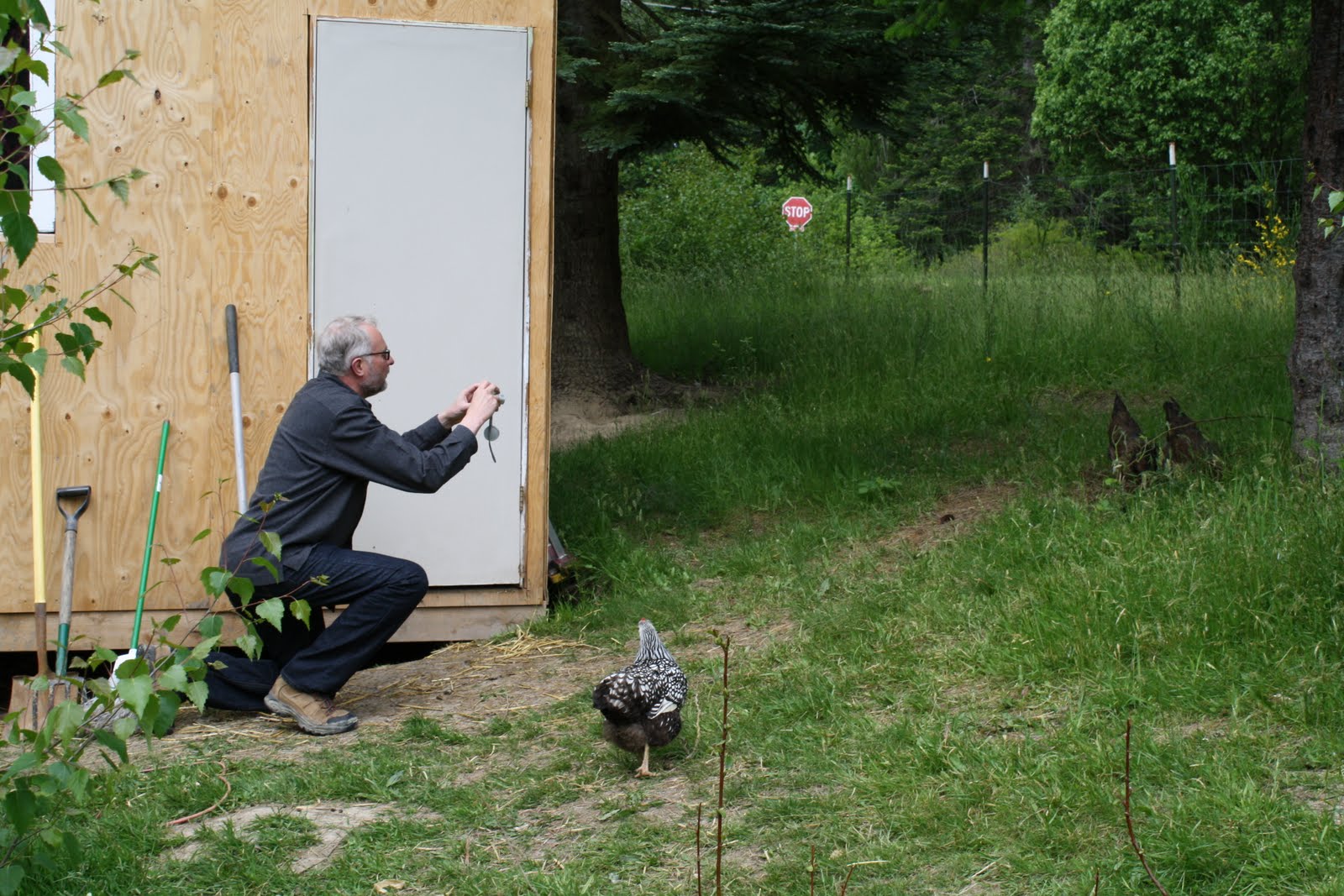
A few weeks ago, a local author named David Toht came by to take some pictures of our animals for a backyard homesteading book that he's written, due out this December.

He got my name from my cousin who lives up the road just a piece, who's family raises goats and honeybees. David was looking for Americauna/Aracauna chickens and LaMancha goats. Bingo!

So we welcomed him over to photograph our critters, on the condition that I could photograph him, photographing our critters. Here he is at work-


He seemed especially fond of our girl, Rosie the Ameracauna Hen.


Ro-Ro in the snow, November 2010.


He also took lots of pics of Chardy-girl, and those gorgeous blue eyes of hers.


As I said, the book is due to be published in December of this year. I can't wait to see if any of our supermodels made the cut!

If you're interested in pre-ordering a copy of the book, or just checking it out, please click through the following handy-dandy link. ;)


Sunday, June 19, 2011

Grow Your Own Challenge - The Rules

I've read and pondered and researched and thought over the guidelines of this Farmer-feed-thyself challenge that we're gearing up for, and I've whittled things down a bit. Here's where we stand now on the rules and details-

*We still haven't picked a hard and fast date to start, but with the weather we're having (another no-grow spring), I'm thinking that we'll have to wait until August before the garden is giving us much of anything. So for now, let's say August 1st.

*We have massively refined our allowances. We will include -
*Coffee (fair trade, organic)
*Oil for cooking (domestic, organic)
*Seasonings/Spices (organic, fair trade)

*What is fair game -
*Anything hunted, caught, foraged, grown or otherwise produced by ourselves.
*Honey, if I can find someone to barter with. I'm not optimistic. :(

*What we anticipate eating -
*Eggs
*Goats Milk/cheese/butter
*Salmon/crab/clams caught/foraged by Bill & I
*Fruits & veggies from the garden
*Foraged berries, mushrooms, greens, etc.
*Our canned jams & jellies from last summer
*Our homemade beer & wine
*Hopefully, our own apple cider & rhubarb wine vinegar

I just know that the things that are going to kick my butt are the minimal dairy and the almost complete lack of carbs and sugar. I am going to be one bitchy sloth the first few days of this challenge, you can count on that!

I have a feeling that my great goat milking motivator will be that morning cup of joe. I have to have cream in my coffee, ergo, I'll have to milk at least once a day for my wake-up cup. This is the aspect of this challenge that intimidates me the most. Milking has not gone well so far, and the ladies are producing less now than the last time I tried milking. This could be rough.

Is there anything that I'm overlooking here? Do these guidelines sound pretty reasonable? I'm excited and nervous as hell to try this feeding myself thing. Cheer me on, friends. I need all of the forward momentum I can get!